

LUNGClear: Lung Cancer Blood Test in Singapore (2026)

LUNGClear™: Lung Cancer Blood Test in Singapore
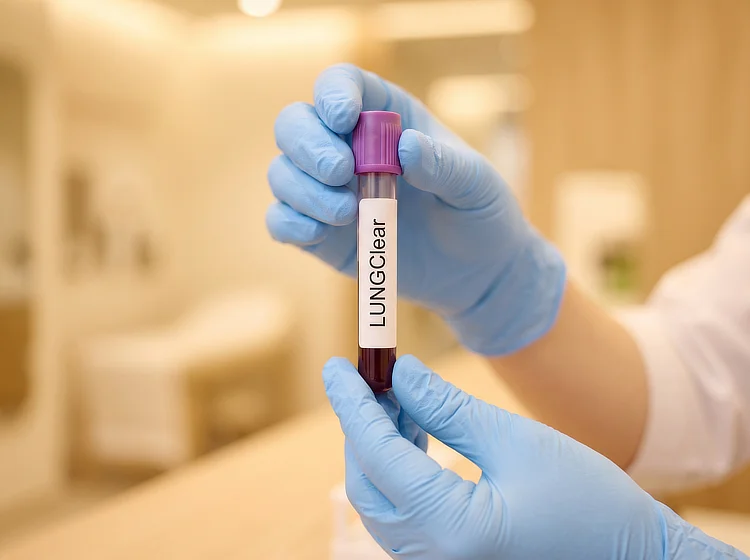
Gloved hands holding a LUNGClear blood test tube in a medical clinic.
Transparent Pricing
Same-Day Appointment
MOH-Registered
Near MRT Stations

Find out your lung cancer risk from a single blood sample for $272.50

  • Measures 12 microRNAs and CEA in your blood, combined into a risk score
  • A simple blood draw, with no radiation exposure
  • Home blood draw available for added privacy and convenience
  • Doctor review of your results with follow-up advice

Located in Tanjong Pagar, Orchard, Jurong & Novena
Medically Reviewed By: Dr Leonard Leng – MBBS, MMed (FM), GDOM, DWD
Last updated: Oct 15, 2026

What Is the LUNGClear Test?

The LUNGClear test is a blood test that estimates how likely you are to have lung cancer, by measuring markers in your blood that tend to change when lung cancer is present. It was developed by Mirxes, a Singapore biotechnology company, and is processed in a clinical laboratory licensed by the Ministry of Health (MOH).

Lung cancer is the third most common cancer in Singapore in both men and women, and it rarely causes symptoms in its early stages. About 4 in 5 cases locally are detected at a late stage, when treatment is usually more difficult.

LUNGClear is designed to assess the risk of having lung cancer, so that further tests, such as a low-dose CT scan, can be arranged and any treatment can start earlier if needed. It does not diagnose lung cancer, and it does not replace a low-dose CT scan for people who are advised to have one.

How Does the LUNGClear Test Work?

The LUNGClear test measures two kinds of markers in your blood, 12 microRNAs and a protein called carcinoembryonic antigen (CEA), and combines them into a single risk score.

MicroRNAs are tiny molecules found in your cells that help control how they work, and some of them enter your bloodstream. People with lung cancer tend to have a different mix of microRNAs in their blood from people without it.

CEA is a protein that some tumours, including lung tumours, can release into the blood. Its level can also be raised by smoking and may be normal in early lung cancer, which is why it is not used on its own.

Who Should Consider the LUNGClear Test?

The LUNGClear test is intended for healthy adults aged 40 and above who have no symptoms of lung cancer and are not at high risk of it.

The main risk factors are:

Current or past smoking
Tobacco smoke contains chemicals that can damage the cells lining the lungs, and the risk stays raised for years after quitting.
Second-hand smoke
Regularly breathing in other people's smoke exposes your lungs to the same harmful chemicals.
Family history of lung cancer
Lung cancer in a parent, sibling or child is linked to a higher risk, partly due to shared genes.
Workplace exposure to asbestos or chemicals
Breathing in asbestos fibres or chemicals such as arsenic, chromium and nickel over many years can damage lung tissue.

Lung cancer can also develop in people with none of these risk factors, and about 1 in 3 people with lung cancer in East Asia have never smoked. Among women with lung cancer in China, more than 8 in 10 have never smoked.

People aged 50 and above who have smoked heavily, now or in the past, are usually advised to have a low-dose CT scan rather than a blood test. This scan uses a small dose of X-rays to take detailed pictures of the lungs.

LUNGClear may suit people who do not qualify for this scan, as it shows whether further tests are needed.

Not sure whether the LUNGClear test is right for you? Book an appointment with our doctors to discuss any symptoms, your risk factors and the most suitable tests for you.
WhatsApp Us

How Is the LUNGClear Test Done?

The LUNGClear test requires just one blood sample of about 5 ml.

Our doctors at ATA Medical can assess any symptoms and risk factors to confirm if LUNGClear is suitable for you. If it is, a blood sample can then be drawn from your arm for laboratory analysis.

Results are usually available within 7 to 10 working days, and our doctors will contact you to explain your risk score, what it means and any follow-up steps.

Nurse in navy scrubs cleaning a patient's inner arm with a swab at a clinic.

What Do Your LUNGClear Results Mean?

LUNGClear reports your result as a risk score that falls into one of three categories:

Risk score Risk category What it means
Below 37.0 Low risk Your likelihood of having lung cancer is not raised
37.1 to 51.8 Intermediate (moderate) risk Your likelihood of having lung cancer is slightly raised, and further tests may be recommended
Above 51.9 High risk Your likelihood of having lung cancer is raised, and further tests, such as a low-dose CT scan, are advised

A high-risk score is not a diagnosis of lung cancer, while a low-risk score cannot rule it out completely. The score estimates your chance of having lung cancer at the time of testing. It cannot tell you whether you might develop lung cancer later in life.

It also does not take your other risk factors into account, such as smoking or family history, so it is best interpreted alongside them.

A low-dose CT scan of the lungs is usually the next recommended step if further tests are advised.

"Early lung cancer usually causes no symptoms, so many cases are only found once the cancer has spread. The LUNGClear blood test offers a simple way to see whether a CT scan of the lungs may be needed, so that any cancer can be found at an earlier, more treatable stage."
— Dr Leonard Leng

"Early lung cancer usually causes no symptoms, so many cases are only found once the cancer has spread. The LUNGClear blood test offers a simple way to see whether a CT scan of the lungs may be needed, so that any cancer can be found at an earlier, more treatable stage."

— Dr Leonard Leng

LUNGClear Test Price

At ATA Medical, we offer LUNGClear and low-dose CT scans, with consultation and results review. If you would like help to stop smoking, we also offer lifestyle medicine services.

Our prices are as follows:

Test Price*^
Consultation From $49.05
LUNGClear Lung Cancer Blood Test $272.50
Lung Scans and Tests
Chest X-Ray $49.05
Low-dose CT Scan $436
Spirometry (Lung Function Test) $54.50
Other Cancer Blood Tests
GASTROClear Stomach Cancer Blood Test $272.50
SPOT-MAS Cancer Blood Test $700
LucenceINSIGHT™ Core (6 Cancers) $654
LucenceINSIGHT™ Me (9 Cancers) $1,308
LucenceINSIGHT™ (12 Cancers) $1,918
LucenceINSIGHT™ Plus (50 Cancers) $3,798
[Optional] Premium Mobile Blood Drawing at Your Home Additional $54.50 (per location up to 5 pax)
*Prices are NETT and inclusive of GST.
^Prices last updated on Oct 15, 2026. While every effort is made to keep pricing information up to date, please contact our team to confirm the latest rates.

Book an Appointment for the LUNGClear Test

ATA Medical @ Tanjong Pagar

72 Anson Rd, #01-02 Anson House, Singapore 079911
Tanjong Pagar Station (EW15)
Mon–Fri: 8:30 AM – 12:30 PM, 1:30 PM – 5:30 PM
Sat: 8:30 AM – 12:30 PM
Sun & PH: Closed
Last appt: 5:15 PM (Mon–Fri), 12:15 PM (Sat)

ATA Medical @ Orchard

1 Orchard Blvd, #05-09 Camden Medical Centre, Singapore 248649
Orchard Boulevard Station (TE13)
Mon–Fri: 8:30 AM – 12:30 PM, 1:30 PM – 5:30 PM
Sat: 8:30 AM – 12:30 PM
Sun & PH: Closed
Last appt: 5:15 PM (Mon–Fri), 12:15 PM (Sat)

ATA Medical @ Jurong

21 Jurong Gateway Rd, #02-08 CPF Jurong Building, Singapore 608546
Jurong East Station (NS1/EW24)
Mon–Fri: 8:30 AM – 12:30 PM, 1:30 PM – 5:30 PM
Sat: 8:30 AM – 12:30 PM
Sun & PH: Closed
Last appt: 5:15 PM (Mon–Fri), 12:15 PM (Sat)

ATA Medical @ Novena

101 Irrawaddy Rd, #09-01 Royal Square Medical Centre, Singapore 329565
Novena Station (NS20)
Mon–Fri: 8:30 AM – 12:30 PM, 1:30 PM – 5:30 PM
Sat: 8:30 AM – 12:30 PM
Sun & PH: Closed
Last appt: 5:15 PM (Mon–Fri), 12:15 PM (Sat)

Navigate to Us

ATA Medical (Anson House)

Nearest MRT: EW15 Tanjong Pagar

ATA Medical (Camden Medical Centre)

Nearest MRT: TE13 Orchard Boulevard

ATA Medical (CPF Jurong Building)

Nearest MRT: NS1/EW24 Jurong East

ATA Medical (Royal Square Medical Centre)

Nearest MRT: NS20 Novena

Frequently Asked Questions (FAQ)

The LUNGClear test estimates the risk of having lung cancer rather than detecting cancer. In clinical testing by Mirxes, most people with lung cancer, including many at stage 1 (the earliest stage), received a raised score. Most people without lung cancer receive a low-risk score, though many with an intermediate score may not have cancer. After a raised score, a low-dose computed tomography (CT) lung scan is usually recommended. If the scan shows an abnormal area, only a biopsy, a lung tissue sample examined in a laboratory, can confirm cancer.
LUNGClear is designed for adults aged 40 and above without symptoms, so it is generally not the appropriate first test for symptoms such as a cough lasting over three weeks, coughing up blood, breathlessness or chest pain. These can also be caused by chest infections, asthma or chronic obstructive pulmonary disease (COPD), a long-term lung disease, and usually need a chest X-ray or computed tomography (CT) scan. A low score may not rule out cancer or these conditions. You should see a doctor promptly about persistent chest symptoms so that they can be assessed and the appropriate tests arranged.
The LUNGClear test has no set repeat schedule, as the score reflects the risk at the time of testing and may not apply to later years. Repeat tests are often considered for people at ongoing risk, such as current smokers or those with a family history. An intermediate-risk result may prompt an earlier repeat test. If the result is high-risk, a low-dose computed tomography (CT) lung scan is usually recommended instead. Your doctor can best advise how often to repeat it, based on any previous result, your age and smoking history.
No, the LUNGClear test is not a genetic test, because it does not analyse the genes a person inherits. It measures microRNAs, tiny molecules that help control how cells work, together with carcinoembryonic antigen (CEA), a protein that some tumours release into the blood. These levels reflect what is happening in the body at the time of testing, rather than a risk passed down in families. Genetic testing for lung cancer is a different test, usually done on tumour tissue after diagnosis to find gene changes that can help guide targeted treatment.
Lung cancer usually does not show up in routine blood tests, such as a full blood count or liver tests. Advanced lung cancer may cause anaemia (a low red blood cell count) or a raised calcium level, but so can many other conditions. Specialised blood tests such as LUNGClear estimate the risk from blood markers but cannot confirm it. Lung cancer is usually found with a chest computed tomography (CT) scan, a detailed X-ray scan, and confirmed with a biopsy, a lung tissue sample examined in a laboratory.
A biopsy is generally the most accurate test for lung cancer and the only way to confirm it. It is usually done when a computed tomography (CT) scan, which builds detailed X-ray images of the chest, shows an abnormal area that could be cancer, and CT can find small tumours that a chest X-ray may miss. In a biopsy, a small piece of tissue is taken from that area, often with a fine needle or a thin camera passed into the airways (bronchoscopy), and examined in a laboratory. Blood tests such as LUNGClear estimate the risk of having lung cancer and may indicate who needs a scan, but they cannot confirm or rule it out.
Symptoms alone cannot show whether cancer is in the lungs, as a lasting cough, breathlessness or chest pain can have other causes, such as infections. The usual first step is an examination and a chest X-ray. If anything looks abnormal or symptoms continue, a detailed computed tomography (CT) scan may be recommended. A biopsy, a tissue sample from any suspicious area examined in a laboratory, confirms whether it is cancer. Without symptoms, people at risk, such as smokers, may be offered a low-dose CT scan, or a specialised blood test such as LUNGClear that estimates their risk.
According to 2025 guidelines from the Academy of Medicine, Singapore, a yearly low-dose computed tomography (CT) scan of the lungs is recommended for people aged 50 to 80 who have smoked at least 20 pack-years, such as a pack a day for 20 years, and who still smoke or quit within the past 15 years. CT screening is not currently recommended for people who have never smoked, although many people with lung cancer in East Asia have never smoked. Some blood tests, such as LUNGClear, estimate lung cancer risk in adults aged 40 and above without symptoms, including those outside these criteria.
No, a lung function test such as spirometry generally cannot detect lung cancer, as it measures the amount and flow of air in the lungs, not whether a tumour is present. A tumour blocking an airway may lower readings such as forced vital capacity (FVC), the air breathed out in one breath, but asthma and chronic obstructive pulmonary disease (COPD), a long-term lung disease, are more common causes. Lung cancer is usually found with a computed tomography (CT) scan of the chest and confirmed with a lung tissue biopsy, while blood tests such as LUNGClear can estimate the risk in people without symptoms.
A cough that does not go away, or a long-standing cough that changes, is generally the most common symptom of lung cancer. The cough may be dry or bring up phlegm, and some people cough up blood. In smokers, the first sign may be a familiar smoker's cough becoming more frequent, deeper or painful. A persistent cough can also be caused by infections, asthma or acid reflux. If you have a cough lasting more than three weeks, or cough up any blood, you should see a doctor promptly.
The warning signs of lung cancer commonly include a cough that lasts or changes, coughing up blood, breathlessness, chest or shoulder pain that may worsen with deep breathing or coughing, a hoarse voice, unexplained weight loss with loss of appetite, and chest infections such as pneumonia that keep returning or are slow to clear. Ongoing tiredness can also occur. These signs can also be caused by conditions other than cancer, such as infections or asthma, but they matter more when they last more than a few weeks, keep getting worse or appear in someone with risk factors such as smoking.
Stage 1 lung cancer, in which the tumour is small and has not spread beyond the lung, often causes no symptoms, so many people feel well. Early symptoms, if any, tend to be mild and easily mistaken for minor illnesses: a slight cough that lingers, mild breathlessness during exertion, tiredness, or a chest infection that takes longer than usual to clear. Stage 1 cancers are often found by chance on a chest X-ray or computed tomography (CT) scan done for another reason. Screening aims to find lung cancer, or identify people at higher risk of it, before symptoms appear.
Pneumonia, tuberculosis (TB), chronic obstructive pulmonary disease (COPD) and benign lung nodules can be mistaken for lung cancer, and lung cancer can also be mistaken for them. Pneumonia and TB are lung infections that can cause cough, fever and shadows on an X-ray, COPD is a long-term lung disease causing cough and breathlessness, and benign nodules are non-cancerous growths, often old scars, that can look like early cancer on a scan. A computed tomography (CT) scan, sometimes repeated to check for growth, and a biopsy of lung tissue are usually needed to tell them apart.
Lung cancer can go unnoticed for months or years, as the lungs have few pain-sensing nerves and a small tumour may not press on nearby structures. Adenocarcinoma, the most common type, usually grows over months to years, while small cell lung cancer, a faster-growing type strongly linked to smoking, can spread within months. Symptoms often appear only once the cancer has spread beyond the lung. If you smoke or have a family history of lung cancer, it may be worth asking a doctor which screening test, if any, suits you.