

Lipoprotein (a) Test
Check your inherited heart disease risk with a one-off blood test for $49.99
- Measures Lp(a), an inherited cholesterol particle that a standard lipid panel does not pick up
- One test usually shows your lifelong Lp(a) level, as your genes determine it
- Home blood draw available for added privacy and convenience
- Doctor review of your results with advice on what should follow

Last updated: Sep 24, 2026
What Is Lipoprotein (a)?
Lipoprotein (a) is a cholesterol-carrying particle in your blood that is linked to a higher
risk of heart attack, stroke and narrowing of the aortic valve. It is written as Lp(a)
and said aloud as "L-P-little-a".
Lp(a) is a type of low-density lipoprotein (LDL) with an extra protein, called apolipoprotein(a),
attached to it.
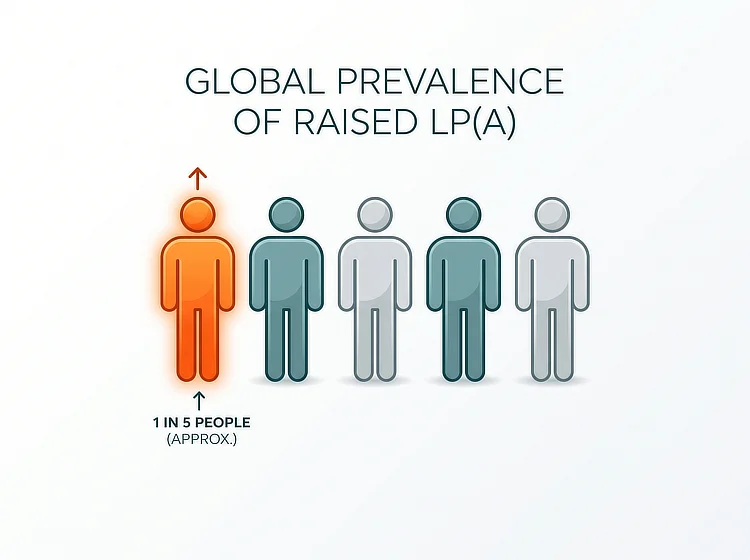
Roughly one in five people worldwide has a raised Lp(a) level, yet most are never tested for it,
since it is not part of a standard cholesterol panel.
Why Lipoprotein (a) Raises Your Heart Risk
Lp(a) is thought to raise heart risk in three ways, so it adds to the risk from your LDL rather than overlapping with it.
- Plaque build-up – Lp(a) becomes trapped in the artery wall and causes inflammation. This leads to plaque, which narrows the artery.
- Blood clotting – Your body uses a protein called plasminogen to dissolve clots. Apolipoprotein(a) has a similar structure and may block plasminogen from working, so clots take longer to break down.
- Aortic valve narrowing – Lp(a) collects in the aortic valve and causes calcium to build up. Over time the valve stiffens, a condition called calcific aortic stenosis, and restricts blood flow out of the heart.
The higher your Lp(a), the higher your risk, and that risk remains even when your LDL cholesterol is well controlled. Someone with a very high Lp(a) can have a normal cholesterol report and still have a much higher lifetime risk of early heart disease.
What Causes High Lipoprotein (a)?
High Lp(a) is almost always inherited, and only a few medical conditions raise it further:
- Genetics – Your Lp(a) level is mainly determined by the genes you inherit. It is low at birth, reaches its adult level by around age 5 and changes little afterwards. If one parent has high Lp(a), each child has about a 1 in 2 chance of inheriting it.
- Kidney disease – Damaged kidneys clear less Lp(a) from your blood, so it builds up. Nephrotic syndrome (where protein leaks into the urine) and advanced kidney disease, including kidney failure treated with dialysis, can raise Lp(a) substantially. It often falls again once kidney function improves.
- An underactive thyroid (hypothyroidism) – Thyroid hormone helps your body break down and clear Lp(a), so when the hormone is low, Lp(a) rises. Treating the thyroid usually brings it back down.
- Menopause – Oestrogen suppresses the production of apolipoprotein(a), so Lp(a) tends to rise modestly as oestrogen falls.
- Inflammation – Lp(a) can rise or fall as part of your body's response to inflammation, so conditions such as rheumatoid arthritis can change it while the inflammation is active.
Conditions that lower Lp(a) may include:
- An overactive thyroid (hyperthyroidism) – Too much thyroid hormone speeds up how fast your body breaks down and removes Lp(a) from your blood, so your level falls.
- Liver disease – The liver is where Lp(a) is made, so a damaged liver makes less of it.
An unusually low Lp(a) level can occasionally be a sign of one of these conditions. Both usually cause other symptoms, such as weight loss and a fast heartbeat with an overactive thyroid, or tiredness and yellowing of the skin with liver disease, and need to be assessed by a doctor.
Lipoprotein (a) vs LDL, ApoB and Apolipoprotein A1
Lipoprotein (a) differs from LDL, ApoB and apolipoprotein A1 because it is inherited. Diet, exercise
and medication can lower the other three, but they have little effect on your lipoprotein (a).
Lipoprotein (a) is often confused with apolipoprotein A1, but they are unrelated. Apolipoprotein A1
is the main protein on high-density lipoprotein (HDL), which carries cholesterol away from your
artery walls, so a higher level is generally good. Lipoprotein (a) carries a different protein,
apolipoprotein(a), and a higher level is linked to higher risk.
| Marker | What it is | What it tells you |
|---|---|---|
| LDL cholesterol | Cholesterol carried inside LDL particles | How much cholesterol is available to form plaque in your artery walls |
| HDL cholesterol | Cholesterol carried inside HDL particles | How much cholesterol is being carried away from your artery walls |
| Apolipoprotein B (ApoB) | The protein on every plaque-forming particle, one per particle | How many plaque-forming particles you have, which can be higher than your LDL cholesterol suggests |
| Apolipoprotein A1 | The main protein on HDL particles | How many HDL particles you have carrying cholesterol away |
| Lipoprotein (a) | An LDL particle with an extra protein, apolipoprotein(a), attached | An inherited risk that is separate from your LDL |
Who Should Get a Lipoprotein (a) Test?
Lp(a) testing is most useful for people with a personal or family history of early heart disease, and international guidelines recommend that every adult has it measured at least once. You are more likely to benefit from testing if you have:
- A parent, sibling or child who had heart disease or a stroke before age 55 (men) or 65 (women)
- Had a heart attack, stroke or stent yourself before those same ages
- Heart disease that has worsened even though your LDL cholesterol is within target
- A parent, sibling or child with high Lp(a), or familial hypercholesterolaemia (an inherited condition that causes very high LDL cholesterol)
- High LDL cholesterol with no clear cause in your diet or lifestyle
- A coronary calcium score (a CT scan of calcium in the heart's arteries) showing more plaque than your other risk factors would predict
- Narrowing of the aortic valve (aortic stenosis)

Repeat testing is rarely needed. One measurement in adulthood is usually enough, unless you develop a condition that changes your Lp(a) level, such as kidney disease or a thyroid problem.
WhatsApp Us
How the Lipoprotein (a) Test Works
The Lp(a) test uses a single blood sample taken from a vein in your arm, and it can be added to a
cholesterol test or a heart screening package from the same sample. You do not need to fast
beforehand.
The visit takes 30 to 60 minutes during off-peak periods. Results are ready in 3 to
5 days and are sent to you by email, and a doctor will explain what your result means for you.
Lipoprotein (a) Normal Range and How to Read Your Result
A normal Lp(a) level is typically below 75 nmol/L (about 30 mg/dL), and a level above 125 nmol/L (about 50 mg/dL) is considered high. Your report may show either unit.
| Lp(a) level (nmol/L) | Approximate equivalent (mg/dL) | What it indicates |
|---|---|---|
| Below 75 | Below 30 | Low risk from Lp(a) |
| 75 to 125 | 30 to 50 | Intermediate risk, best interpreted alongside your other risk factors |
| 125 to 430 | 50 to 180 | High risk, and a reason to manage your other risk factors more tightly |
| Above 430 | Above 180 | Very high risk, comparable to that of familial hypercholesterolaemia |
How to Lower Lipoprotein (a)
Lipoprotein (a) can be lowered partly with prescription treatments, such as PCSK9 inhibitors, niacin and lipoprotein apheresis.

- PCSK9 inhibitors – These injections block a protein called PCSK9, which helps your liver clear more cholesterol-carrying particles from your blood, including some Lp(a). They lower Lp(a) by about 25 per cent, and are prescribed mainly to lower LDL cholesterol, which large trials have shown reduces heart attacks and strokes.
- Niacin – This high-dose form of vitamin B3 is thought to reduce how much Lp(a) your liver makes. It is rarely prescribed for this, as large trials found it did not reduce heart attacks or strokes.
- Lipoprotein apheresis – A machine filters Lp(a) out of your blood in sessions similar to dialysis, and the level rises again between sessions. It is a hospital treatment for very high levels with worsening heart disease.
- New Lp(a) medicines – These block the instructions your liver uses to make apolipoprotein(a), so it makes much less Lp(a). They are still in trials and not yet approved.
Lp(a) cannot be lowered naturally, as diet, exercise and weight loss have little effect on it, and
statins may even raise it slightly.
A high Lp(a) is strongly linked to heart attacks and strokes, and trials are still testing whether
lowering Lp(a) itself prevents them. Knowing your level still helps, as international guidelines
recommend tighter control of your other heart risks when Lp(a) is high: a lower LDL cholesterol
target, often with a statin, well-controlled blood
pressure and blood sugar, no smoking and regular exercise.
A coronary calcium score can also show whether plaque has already formed in your heart's arteries.
Your parents, siblings and children may want to be tested too.
"Lipoprotein (a) is mainly determined by the genes you inherit, so for most people one
test shows their level for life. Knowing your level shows you why controlling the risks
you can change, such as your LDL cholesterol and blood pressure, matters even more."
— Dr Leonard Leng
"Lipoprotein (a) is mainly determined by the genes you inherit, so for most people one test shows their level for life. Knowing your level shows you why controlling the risks you can change, such as your LDL cholesterol and blood pressure, matters even more."
— Dr Leonard Leng
Lipoprotein (a) Test Price in Singapore
At ATA Medical, we offer the lipoprotein (a) test on its own or alongside other cardiovascular markers, with consultation and results review. Prices are as follows:
| Test / Treatment | Price* |
|---|---|
| Consultation | From $49.05 |
| Lipoprotein (a) | $49.99 |
| Apolipoprotein B (ApoB) | $32.70 |
| High-sensitivity CRP (hsCRP, an inflammation marker) | $38.15 |
| CT Calcium Score | $403.30 |
|
Essential Lipid Profile
Full Cholesterol Test (Total, LDL, HDL, Triglycerides, HDL Ratio)
|
$21.80 |
|
Cardiac Screening 3
Essential Lipid Profile + Apolipoprotein B (ApoB) + HsCRP
|
$63.22 |
|
Cardiac Screening 4
Cardiac Screening 3 + Homocysteine + Fasting Insulin + Glucose. Note: Fasting is
required for accurate results of Fasting Insulin and Glucose.
|
$172.22 |
| PCSK9 Inhibitor Injections (for High LDL Cholesterol) | |
| Evolocumab (140 mg): Twice a month** | $123.00 per injection |
| Inclisiran: Typically every 6 months | $3,828.00 per injection |
^Prices last updated on Sep 24, 2026. While every effort is made to keep pricing information up to date, please contact our team to confirm the latest rates.
**Your doctor will discuss the most suitable dose and schedule of evolocumab with you.
The Lp(a) test is not covered by Healthier SG Screening, so it is not subsidised under the programme.
How Do I Book a Lipoprotein (a) Test?
ATA Medical @ Tanjong Pagar
Sat: 8:30 AM – 12:30 PM
Sun & PH: Closed
Last appt: 5:15 PM (Mon–Fri), 12:15 PM (Sat)
ATA Medical @ Orchard
Sat: 8:30 AM – 12:30 PM
Sun & PH: Closed
Last appt: 5:15 PM (Mon–Fri), 12:15 PM (Sat)
ATA Medical @ Jurong
Sat: 8:30 AM – 12:30 PM
Sun & PH: Closed
Last appt: 5:15 PM (Mon–Fri), 12:15 PM (Sat)
ATA Medical @ Novena
Sat: 8:30 AM – 12:30 PM
Sun & PH: Closed
Last appt: 5:15 PM (Mon–Fri), 12:15 PM (Sat)