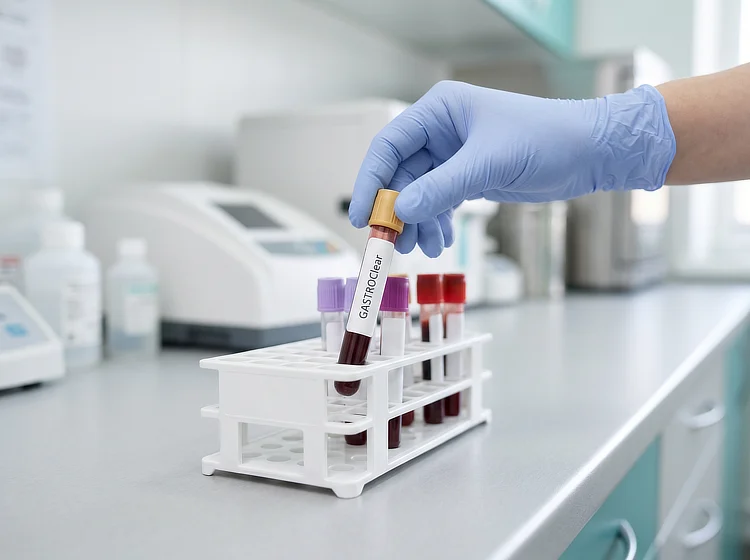
GASTROClear™: Stomach Cancer Blood Test in Singapore
Transparent Pricing
Same-Day Appointment
MOH-Registered
Near MRT Stations
Check your risk of stomach cancer with a single blood test for $272.50
-
Measures 12 microRNAs in your blood linked to stomach cancer, combined into a risk score
-
A simple blood draw, with no fasting or sedation needed
-
Home blood draw available for added privacy and convenience
-
Doctor review of your results with follow-up advice
Located in Tanjong Pagar, Orchard, Jurong & Novena
What Is the GASTROClear Test?
The GASTROClear test is a blood test that estimates your risk of having stomach cancer by measuring 12 microRNAs, tiny molecules in your blood whose pattern tends to differ when stomach cancer is present.
It was developed in Singapore by Mirxes together with A*STAR, the National University Hospital and Tan Tock Seng Hospital, and is approved by the Health Sciences Authority (HSA).
Stomach cancer, also called gastric cancer, often causes no symptoms in its early stages. About 6 in 10 stomach cancers in Singapore are found at a late stage, when the cancer is usually harder to treat. GASTROClear is designed to identify people who are more likely to have stomach cancer, so that they can have a gastroscopy (a camera examination of the stomach) and, if needed, begin treatment earlier.
It does not diagnose stomach cancer or replace a gastroscopy, as only a biopsy taken during a gastroscopy can confirm stomach cancer.
How Does the GASTROClear Test Work?
GASTROClear measures the levels of 12 microRNAs in your blood sample and combines them into a single risk score from 0 to 100.
MicroRNAs are tiny molecules that help control which proteins your cells make. Cells release some of them into the bloodstream, and the pattern found in people with stomach cancer differs from the pattern in people without it.
The laboratory measures the 12 microRNAs, and an algorithm compares your pattern with those of people with and without stomach cancer to produce your score. The higher the score, the more likely it is that stomach cancer is present at the time of the test.
Who Should Consider the GASTROClear Test?
The GASTROClear test is suitable for adults aged 40 and above with at least one risk factor for stomach cancer.
The main risk factors are:
Current or past H. pylori infection
This common bacterium can keep the stomach lining inflamed for years, and the damaged cells may eventually turn cancerous.
Chronic gastritis
Long-term inflammation of the stomach lining can cause changes in its cells that may come before cancer.
Family history of stomach cancer
Having a parent, sibling or child with stomach cancer is linked to a higher risk, through shared genes, eating habits and H. pylori infection.
Diet high in salted, smoked, pickled or fried foods
Salt and the chemicals in smoked and processed meats can damage the stomach lining. A diet low in fruit and vegetables adds to the risk.
Smoking
Chemicals in tobacco smoke can damage the cells of the stomach lining.
Past stomach polyps or lymphoma
Some stomach polyps can turn into cancer over time, and a past stomach lymphoma is linked to a higher risk.
The test can also suit people with these risk factors who are not ready for a gastroscopy, as it can indicate whether one is needed.
Unsure whether the GASTROClear test suits you?
Book an appointment with our doctors to discuss your risk factors and any symptoms, and whether a blood test or a gastroscopy is the right first step.
WhatsApp Us
How Is the GASTROClear Test Done?
The GASTROClear test needs only a blood sample, and you do not need to fast or prepare beforehand.
At ATA Medical, we start with a consultation, where our doctors review your risk factors and any symptoms to check that the test suits you. If it does, a blood sample is taken from your arm and sent to the laboratory.
Your results are usually ready in 7 to 10 working days. Our doctors will then contact you to explain your risk score and what it means for you.
What Do Your GASTROClear Results Mean?
Your GASTROClear result is a risk score from 0 to 100, which places you in one of three risk categories:
|
Risk score
|
Risk category
|
What it means
|
| 0 to 39.9 |
Low risk |
Your likelihood of having stomach cancer is not raised |
| 40.0 to 50.0 |
Intermediate (moderate) risk |
Your likelihood of having stomach cancer is slightly raised, and further assessment or a repeat test may be recommended |
| 50.1 to 100 |
High risk |
Your likelihood of having stomach cancer is raised, and a specialist assessment, usually including a gastroscopy, is advised |
A high-risk result does not mean you have stomach cancer, and a low-risk result does not completely exclude it. The score reflects the likelihood of stomach cancer being present at the time of the test, so it does not predict whether you will develop stomach cancer in the future.
Our doctors can refer you to a specialist for a gastroscopy if your result is high.
"Stomach cancer often causes no symptoms until it is advanced. A simple GASTROClear blood test shows people with risk factors whether they may need a gastroscopy, while any cancer is more likely to be treatable."
— Dr Leonard Leng
"Stomach cancer often causes no symptoms until it is advanced. A simple GASTROClear blood test shows people with risk factors whether they may need a gastroscopy, while any cancer is more likely to be treatable."
GASTROClear Test Price
At ATA Medical, we offer the stomach cancer blood test (GASTROClear) and H. pylori tests, with consultation and results review. For risk factors you can change, such as diet and smoking, we also offer lifestyle medicine services.
Our prices are as follows:
*Prices are NETT and inclusive of GST.
^Prices last updated on
Oct 15, 2026. While every effort is made to keep pricing information up to date, please contact our team to confirm the latest rates.
Book an Appointment for the GASTROClear Test
ATA Medical @ Tanjong Pagar
72 Anson Rd, #01-02 Anson House, Singapore 079911
Tanjong Pagar Station (EW15)
Mon–Fri: 8:30 AM – 12:30 PM, 1:30 PM – 5:30 PM
Sat: 8:30 AM – 12:30 PM
Sun & PH: Closed
Last appt: 5:15 PM (Mon–Fri), 12:15 PM (Sat)
ATA Medical @ Orchard
1 Orchard Blvd, #05-09 Camden Medical Centre, Singapore 248649
Orchard Boulevard Station (TE13)
Mon–Fri: 8:30 AM – 12:30 PM, 1:30 PM – 5:30 PM
Sat: 8:30 AM – 12:30 PM
Sun & PH: Closed
Last appt: 5:15 PM (Mon–Fri), 12:15 PM (Sat)
ATA Medical @ Jurong
21 Jurong Gateway Rd, #02-08 CPF Jurong Building, Singapore 608546
Jurong East Station (NS1/EW24)
Mon–Fri: 8:30 AM – 12:30 PM, 1:30 PM – 5:30 PM
Sat: 8:30 AM – 12:30 PM
Sun & PH: Closed
Last appt: 5:15 PM (Mon–Fri), 12:15 PM (Sat)
ATA Medical @ Novena
101 Irrawaddy Rd, #09-01 Royal Square Medical Centre, Singapore 329565
Novena Station (NS20)
Mon–Fri: 8:30 AM – 12:30 PM, 1:30 PM – 5:30 PM
Sat: 8:30 AM – 12:30 PM
Sun & PH: Closed
Last appt: 5:15 PM (Mon–Fri), 12:15 PM (Sat)
Navigate to Us
Frequently Asked Questions (FAQ)
In studies by Mirxes involving over 5,000 people in Singapore and Korea, GASTROClear detected most stomach cancers, including many at an early stage. It estimates risk, however, rather than giving a diagnosis. Some people with a high score are found to be cancer-free at a gastroscopy (a camera examination of the stomach), and a low score makes cancer less likely without excluding it. Only a biopsy, a small tissue sample taken during a gastroscopy, can confirm stomach cancer, so the score is mainly used to decide whether one is needed.
The GASTROClear test is designed mainly for people without symptoms and does not replace an assessment of existing symptoms. Persistent indigestion or upper stomach pain is more often caused by gastritis or a stomach ulcer, and a gastroscopy (a camera examination of the stomach) is usually the more direct way to find the cause. A low GASTROClear score would not exclude cancer or these conditions. If you are unsure, see a doctor first, who can assess your symptoms and advise whether a gastroscopy, a GASTROClear test or both suit you.
The GASTROClear test can be repeated about once a year after a low-risk result, or at an interval a doctor recommends. After an intermediate-risk result, a repeat test may be advised sooner, and a gastroscopy (a camera examination of the stomach) may be considered alongside other findings. A high-risk result may lead to a specialist assessment and a gastroscopy rather than another blood test. It is best to discuss how often to test with a doctor, based on any previous result, your age and your risk factors.
Yes, GASTROClear was approved by Singapore's Health Sciences Authority (HSA) in 2019, and it also carries CE marking for sale in the European Union. It was developed in Singapore by Mirxes with A*STAR, the National University Hospital and Tan Tock Seng Hospital. HSA approval means the test meets the HSA's requirements for use in Singapore, but it estimates risk rather than diagnosing stomach cancer. A high score means further tests, such as a gastroscopy (a camera examination of the stomach), are recommended to confirm or exclude stomach cancer.
Routine blood tests in a standard health screening usually do not detect stomach cancer. A full blood count may show anaemia (a low red blood cell count) if a tumour bleeds slowly, but many other conditions cause anaemia too. The GASTROClear test is a specialised blood test that measures 12 microRNAs, small molecules whose pattern tends to change when stomach cancer is present, to estimate the risk of stomach cancer. A gastroscopy with a biopsy, a small tissue sample checked in a laboratory, is still needed to confirm it.
An abdominal ultrasound is generally not reliable for detecting stomach cancer, because gas and food in the stomach block the view and small tumours are easily missed. A computed tomography (CT) scan may show a larger tumour or a thickened stomach wall, but it is mainly used after diagnosis to check whether the cancer has spread, and magnetic resonance imaging (MRI) is used less often. Stomach cancer is diagnosed with a gastroscopy, a camera examination of the stomach, and a biopsy. A GASTROClear blood test can estimate stomach cancer risk beforehand and show whether a gastroscopy is needed.
Only a gastroscopy with a biopsy can confirm stomach cancer: a camera examines the stomach lining, and a small tissue sample is checked in a laboratory. Symptoms alone cannot confirm it, as persistent indigestion or upper stomach pain is far more often caused by gastritis, ulcers or acid reflux. Earlier tests may include a breath test for Helicobacter pylori (H. pylori), a common stomach bacterium, or a GASTROClear blood test to estimate cancer risk. If your stomach symptoms keep returning, it is advisable to see a doctor, who can assess them and arrange a gastroscopy if needed.
Most stomach cancers are diagnosed at a late stage, and about 6 in 10 cases in Singapore are found at stage 3 or 4, when the cancer has spread to nearby lymph nodes or, at stage 4, to other organs. Early stomach cancer often causes no symptoms, or vague ones such as indigestion that are easily put down to gastritis or acid reflux. Singapore also has no national screening programme for stomach cancer, unlike colorectal, breast and cervical cancer, so many cases are only investigated once symptoms become persistent.
The first warning signs of stomach cancer are usually vague, and stage 1 stomach cancer, which is confined to the inner layers of the stomach wall, often causes no symptoms at all. Early symptoms, if any, tend to be indigestion or heartburn, mild discomfort in the upper stomach, bloating, feeling full after small meals and slight nausea. These are much more often caused by gastritis or acid reflux, so early stomach cancer is easy to overlook. Indigestion that lasts more than about three weeks, or keeps returning, should be checked by your doctor.
The warning signs of stomach cancer commonly include persistent indigestion or heartburn, upper stomach pain, feeling full quickly after small meals, loss of appetite with unexplained weight loss, nausea or vomiting, black or tarry stools, and tiredness or breathlessness from anaemia (a low red blood cell count). Difficulty swallowing can also occur when a tumour is near the top of the stomach. These symptoms are usually caused by conditions other than cancer, such as gastritis or a stomach ulcer, but they matter more when they last more than about three weeks or keep getting worse.
The red flags for stomach cancer, also called alarm symptoms, are vomiting blood, black or tarry stools, unexplained weight loss, difficulty swallowing, persistent vomiting, a lump in the upper stomach and anaemia (a low red blood cell count) with no clear cause. Persistent new indigestion in middle age or later also needs prompt assessment. These symptoms can also be caused by other conditions, such as a bleeding stomach ulcer, but they usually need a gastroscopy. You should see a doctor promptly if you notice any of them, and seek emergency care if you vomit blood.
Stomach cancer symptoms are generally the same in women and men: persistent indigestion, upper stomach pain, feeling full after small meals, loss of appetite, weight loss and, in later stages, vomiting or black stools. Stomach cancer is less common in women than in men. In women, bloating and abdominal discomfort may also be put down to periods or ovarian conditions, which can delay an assessment of the stomach. Persistent symptoms in women therefore need the same medical assessment as in men, whatever other cause seems likely.
Gastritis, stomach ulcers, acid reflux and functional dyspepsia are most often mistaken for stomach cancer, and stomach cancer is often mistaken for them. Gastritis is inflammation of the stomach lining, an ulcer is an open sore in the stomach or upper intestine, and functional dyspepsia is ongoing indigestion with no visible cause. All can cause upper stomach pain, bloating or nausea. A GASTROClear blood test can estimate whether stomach cancer is likely, but only a gastroscopy, a camera examination of the stomach, shows which condition is present. Any ulcer or abnormal area is usually biopsied to rule out cancer.
Most people diagnosed with stomach cancer are aged 60 and above, and the risk rises steadily with age; it is generally uncommon before 40. Men are diagnosed more often than women. Some cases occur in younger adults, particularly those with a strong family history of stomach cancer or hereditary diffuse gastric cancer, a rare inherited syndrome that raises the risk of an aggressive form of the disease. Long-term infection with Helicobacter pylori (H. pylori), a common stomach bacterium, smoking and a diet high in salted or pickled foods also raise the risk at any age.
Stomach cancer can be present for months or years without causing symptoms, as early tumours are small and limited to the inner lining of the stomach. It usually develops slowly over many years, often starting with long-term inflammation from Helicobacter pylori (H. pylori), a common stomach bacterium, or chronic gastritis. This inflammation can lead to precancerous changes, such as intestinal metaplasia, where the stomach lining begins to resemble the intestine's lining. The pace varies between people and types of stomach cancer.
Gastric cancer spreads at different speeds depending on its type. The intestinal type, the more common form, tends to grow slowly over years, while the diffuse type, which spreads through the stomach wall rather than forming a lump, can grow and spread more quickly and is harder to see on a gastroscopy (a camera examination of the stomach). Once the cancer grows through the stomach wall, it may spread to nearby lymph nodes, the liver or the lining of the abdomen, called the peritoneum. Finding it before it spreads generally allows more treatment options.
Early stomach cancer can often be cured, and outcomes are generally better before it spreads beyond the stomach. Early cancers may be removed during a gastroscopy (a camera examination of the stomach) or with a gastrectomy, an operation to remove part or all of the stomach. A specialised blood test like GASTROClear can indicate which people with risk factors may need a gastroscopy, so cancer may be found earlier. Cancer that has spread to distant organs is much harder to cure, so treatment then mainly aims to control it and relieve symptoms.
Long-term survival of 20 years or more after a stomach cancer diagnosis is possible, mainly for people whose cancer was found early and removed with surgery or during a gastroscopy (a camera examination of the stomach). After treatment, regular follow-up is usually advised to check that the cancer has not returned, and many people live for many years. The outlook is much less favourable when stomach cancer is found at an advanced stage, and it depends on the type of cancer, how far it has spread, overall health and the response to treatment.